Posts

Where is Knockanduns?

Image
The placename Knockanduns appears several times in the registers of Ballykelly and Bovevagh Presbyterian Presbyterian churches both near the town of Limavady. Bovevagh Presbyterian register of baptisms: Born 27 Aug 1823 baptised 10 Sept 1823 Mary Anne dau of John Taggart & Mary Ann Whiteside of Knockanduns Born 6 Aug 1824 baptised 18 Aug 1824 James son of Joseph Gallagher & Rose Robison of Knockanduns Ballykelly Presbyterian register of marriages  August 3 1811 Mathew Gray of Bevedagh married to Charlot Cairns of Ballynarg – Mr Gray certificated for Mathew and Thomas Cairns father of Charlott for her – said Thomas with Joseph Patton of Knockanduns other witness.  Bovevagh Presbyterian marriage register  Married 6 July 1824 Samuel Patten of Knockanduns to Ann Douglas (dau of William Douglas) of Boigh. Knockanduns is not listed as an official townland for the Roe valley area. I consulted the Ordnance Survey Memoirs Index of townland names (published by the Institu...

Arctic Ireland 1740-1741

Image
Climate fluctuations have a great impact on human history and society. The Medieval Warm period lasted c1750AD to 1300AD to be followed by a period known as the Little Ice Age c1300-1850. The former is always preferable to the latter as illustrated by a little known event of Irish History known as the Great Frost of 1740-1741. The Great Frost The Great Frost began on the  last day of 1739. Rivers and lakes, including Lough Neagh, froze over, mills ground to a halt and travel was restricted.  Devastating Impact:  The cold led to the total crop failure of crops resulting in famine and starvation, paticularly amongst the poorer classes resulting in massive spike in deaths. The famine lasted 21 months. The impact of this extreme weather event has been well documented in David Dickson's book Arctic Ireland (unfortunately now out of print).

Quadruple family tragedy 1872 & a murder 1915 & a naval hero 1950 - the Johnston family of Dooraa, Kesh, Co Fermanagh

Image
QUADRUPLE FAMILY TRAGEDY, 1872 Occasionally, when researching families, one uncovers other unrelated families that catch the attention. Whilst looking for a death record for another Johnston family I came across a striking triple death registration for three sons of an Andrew Johnston residing in the townland of Doora, near the village of Kesh, Co. Fermanagh. The three deaths were all registered on the same day, the sixth of April 1872 and made for very sad reading. Andrew had lost three sons within one month; William Andrew aged 4, George aged 9 and Acheson aged 13. It seems that typhoid fever (spread by a bacteria called Salmonella typhi), carried in contaminated water had struck the family with devastating consequences. Outbreaks of typhoid fever were not uncommon in 19th century Ireland.  Having caught my attention I had a look at the family of Andrew Johnston and discovered that he had lost another son Francis Johnston, aged 16 years to the same disease on 16 May 1872. Four so...

The siege of Derry - myths and genealogy. The case against Gideon Murray.

Image
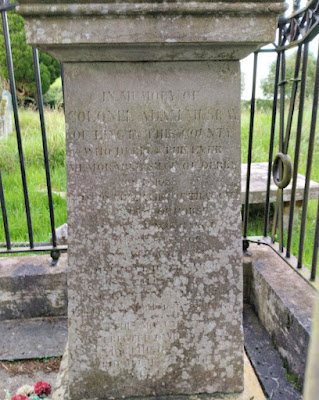
  Siege Myths and genealogy Colonel Adam Murray served as commander of the Williamite cavalry during the Siege, having raised a troop of 30 Horsemen for the city's defence. He was a key figure in the battles of Pennyburn (where he killed the French General Maumont in a sword fight) and Windmill Hill. Some siege accounts relate that the Jacobites captured Murray's elderly father, Gideon Murray and threatened to hang him unless the city surrendered. Apparently, Gideon Murray encouraged the defenders to continue fighting and to never surrender. Old Gideon Murray was spared by the Jacobites but died circa 1690. A Genealogical and Heraldic Dictionary of the Landed Gentry of G.B &  Ireland, (1863), volume 2 page 1058 by Bernard Burke states that Gideon Murray went to Ireland c1648 and settled at Ling in Cumber parish in Co. Derry. Murray  reputedly held considerable interest in the lands granted to the Skinners company, the lease of which passed from the family about 1805. ...

Snippets from the Derry Journal

Image
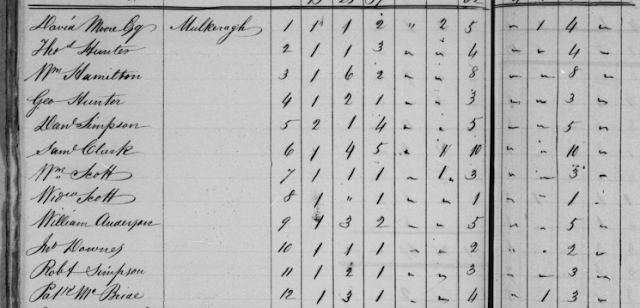
Local newspapers provide a rich font of information on regional history and give some insight into the daily lives of our ancestors. The Derry Journal was first published in 1772 and was first launched as the Londonderry and Donegal & Tyrone Advertiser. Below are a few snippets from the Derry Journal that are almost 200 years old and added commentary to give some context for the entries: Derry Journal 23 Sept 1828 Newtown Limavady cattle show - The Kennaght Branch of the North-West Society 5 Sept 1828: Prizes awarded - To farming servants for long and faithful service - first premium was awarded to Patrick McBride who has served under Mr William Scott of Mulkeeragh for 37 years; 2nd premium to David McKee who served Mr William Patton for 26 years. Note - many prize winners were listed in the article, many familiar names of local farmers all members of the Kennaght Branch of the NW Society. What is interesting here is the naming of farm servants - normally people who would not appea...

The early history of Artikelly village near Limavady

Image
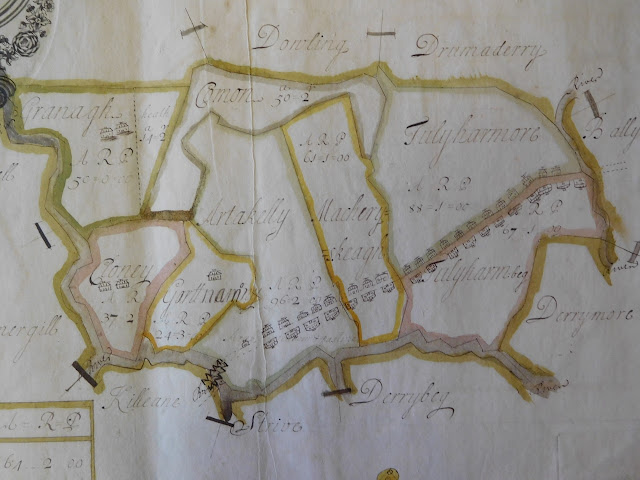
Artikelly is a small village and townland one kilometer north-east of Limavady, which in the census of 2011 had a population of 360 people. The Haberdashers' company of London was granted this area in the plantation scheme but soon farmed out the land to the highest bidder Sir Robert McClelland of Bombay, Kirkcudbrightshire, Scotland and his main headquarters was located at Ballycastle (Aghanloo) but also a settlement was built at Artikelly. The village has quite an interesting history and was once a settlement of some prominence in the Roe valley in the seventeenth century. The Haberdashers' had their centre in the northern section of their estate where a castle was built at Ballycastle on a natural bank on what was Campbells farm (in 1983). The Haberdashers' built a linear village at Artikelly, one mile from the castle consisting of one street with two rows of thatched single-story cottages set in rectangular plots. William Babington opened an inn in Artikelly (before 161...

Roy Orbison and his Lurgan roots

Image
 In the spring of 1968 Roy Orbison (the Big O) sang at the Regal cinema in Lurgan. Orbison was probably not aware that he may have been performing in his ancestral home, the place of  his roots in Lurgan, Co Armagh. Orbison (Orbinson) is a rare name in Ulster associated with the parishes of Shankill (Lurgan) and Donaghcloney the latter in Down and the former in Armagh, but both are very close to the town of Lurgan. Roy Orbison's putative ancestor, ' Thomas Orbison was born near Lurgan, Ireland about 1715, emigrated to America about 1740 and purchased a farm near Welsh Run now Franklin Co (then in Peter's township, Cumberland Co), Pennsylvania, where he resided until his death March 1779 ' (Source - Commemorative biographical encylcopedia of the Juniata Valley: comprising the counties of Huntingdon, Mifflin, Juniata and Perry, Pennsylvania, containing sketches of prominent and representative citizens and many of the early settlers; volume 1, 1897 Chambersburg, P.A. pub b...