Posts

Cloncha parish registers Co Donegal baptisms 1669-1783
Image
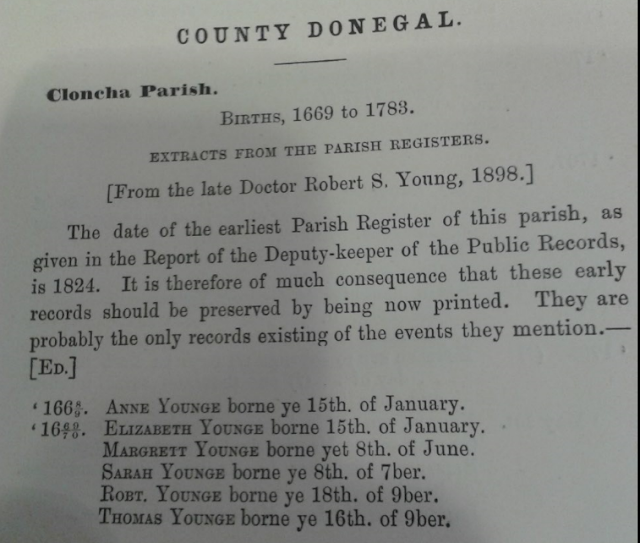
According to the PRO Ireland the date of the earliest Parish register for the parish of Cloncha in Donegal, as given in the Report of the Deputy-Keeper of the Public records is 1824. The following register(s) for Cloncha Church of Ireland were destroyed in the fire of 1922 namely baptisms 1825-1876, marriages 1823-1844 and burials 1829-1877. There was, however, an earlier register and transcripts were made of baptisms 1669-1783 by Dr Robert S Young that were published in Volume 5 of the Journal for the Association of the memorials of the Dead, Ireland (1903). These appear to have been selected entries transcribed by Dr Young but are valuable nonetheless: Dr Young's extracts from the parish registers of Cloncha A transcript of these valuable registers is available on Lindel Buckley's excellent website on Donegal Genealogy linked below: http://donegalgenealogy.com/clonchareg.htm
The RCB and Church of Ireland registers - what has survived?

Image
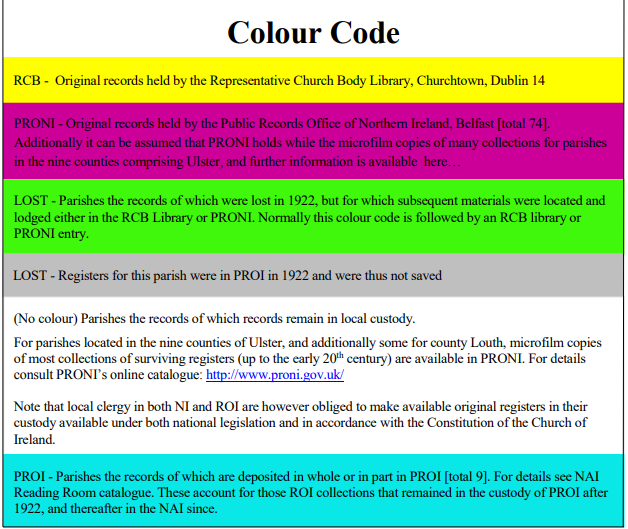
The REPRESENTATIVE CHURCH BODY LIBRARY exists to provide a repository in which the archives and manuscripts  of the Church of Ireland can be stored, arranged and made available to researchers in a systematic fashion. https://www.ireland.anglican.org/about/rcb-library The RCB has produced a searchable PDF file containing information on the registers for every parish in Ireland including those destroyed in the fire in the PRO in 1922. The PDF file is a most useful tool in searching out the history of the registers for Church of Ireland parishes.  The List of Church of Ireland Parish Registers was originally compiled in-house for the Public Record Office of Ireland (PROI), now the National Archives of Ireland (NAI), by Miss Margaret Griffith (1911-2001) Deputy Keeper of the PROI during the 1950s. Griffith’s original list (which was titled the Table of Parochial Records and Copies) was based on inventories returned by the parochial officers about the year 1875/6, ...

The Berryman murders Garvagh

Image
John Berryman. On the 20th of August 1908, John Berryman was hanged for the murder of his brother and his sister-in-law after a fall out over shares on a farm. William Berryman was the oldest brother and in 1906 he married Jane Turner from Ballinameery. Before the marriage, things had been fine between the brothers. They had equal shares on a prosperous farm near Garvagh. After the wedding, John sold his shares to William on the understanding he continued to live and work on the farm. The relationship between the two brothers soured and John regretted selling his share and arguments on the matter became frequent. On Wednesday 18th March the brothers were sitting in the kitchen eating a meal that Mrs Berryman had prepared. Suddenly John attacked William with a hammer and beat him around the head. William sustained a fractured skull and as he lay dying on the floor, John left the house. Nancy Doherty who had been passing heard Mrs Berryman shouting at John that he had killed his broth...

Creation of Co Londonderry 1613

Image
The counties of Coleraine, Donegal and Tyrone along with Armagh and Monaghan were created in 1585. The county of Cavan, which had been included in the province of Connaught, was later added to the province of Ulster.  County Coleraine which had been formed from O’Cahan’s country lay to the north of the Sperrins between the rivers Foyle and Bann. Co. Coleraine was actually quite small consisting of only two ancient areas known as Anagh and Limavaddye. Two new baronies were created and called Tirkeeran and Keenaught, respectively to form the new county. COUNTYE COLRANE On the 28th January 1610 articles of agreement were signed between the City of London and James I, king of England and Scotland, for the colonisation of an area in the province of Ulster which was to become the county of Londonderry. This agreement modified the original plan for the Plantation of Ulster which had been drawn up in 1609. The area now to be allocated to the City of London included the then county o...

Understanding counties and baronies

Image
From the seventeenth century until the middle of the nineteenth century the administrative divisions within Ireland were Townland, Parish, Barony, County and Province. The historic province of Ulster consists of nine counties. The county system as a form of territorial division was introduced into Ireland shortly after the Norman Conquest in the late twelfth century. The creation of counties was gradual, however, and did not reach into Ulster until the late sixteenth century. The counties of Coleraine, Donegal and Tyrone along with Armagh and Monaghan were created around 1585. Sometime later the county of Cavan, which had been included in the province of Connaught, was added to the province of Ulster.  The new county of Londonderry was not formed until 1613 and was created out of the existing county of Coleraine and parts of the neighbouring counties of Donegal, Antrim and Tyrone. Baronies The barony was a unit used in Ireland between the sixteenth and ninet...

Understanding townlands

Image
Understanding townlands The townland is the smallest administrative territorial unit in Ireland, varying in size from a single acre to over 7,000 acres. Originating in the older Gaelic dispensation, townlands were used as the basis for British administration in Ireland and of leases in the estate system, and subsequently to assess valuations and tithes in the nineteenth century. The townland remained the basic recording unit within the census returns before 1911. There are over 60,000 townlands in Ireland (almost 17,000 of these are in Ulster). Ireland then is made up of a gigantic jigsaw puzzle of townlands, each one unique and a visible sign of our topographical and genealogical history. Townlands are of ancient origin an identifiable marker of both landscape and history. Myriad townlands in the Ballymoney & Kiraughts area Townlands were used in the British system of administration during the Ulster plantation. Unfortunately, some if not many of the Gaelic names...

Understanding parishes

Image
CHURCH AND CIVIL PARISHES Records may identify a civil or church parish as a place of origin but in some cases it may be unclear which type of parish a record refers to. In general, a reference in a civil record refers to a civil parish in Ireland.The Church of Ireland (Established Church) parish boundaries generally followed those of the civil parishes. However, there may not have been enough members to support a Church of Ireland church in each civil parish. Consequently, parishes joined together as one functional parish. Sometimes more than one Church of Ireland parish existed within a civil parish. This was especially true in Ulster where there were greater numbers of Church of Ireland members. Religious denominations in Ireland other than the Catholic Church and Church of Ireland did not use a parish system. A parish named for a Presbyterian, Methodist, Moravian, Baptist, Congregational, Mormon, or Quaker ancestor is most likely the civil parish. Civil parishes in Co L...