Posts

Terrydoo Clyde and Walker

 Townlands were sometimes subdivided and named after the family with the strongest lease - Terrydoo in the parish of Balteagh, Limavady was a case in point leaving us with Terrydoo Clyde and Terrydoo Walker. Both the Clyde and Walker families can be found in Terrydoo in the 1740 Protestant householders' survey. Three heads of household were named Clyde - Adam, John and Michael. One head of household was named Walker - John Walker.  From the registry of deeds, we learn a little more about the Clyde family. Adam Clyde listed in the 1740 Protestant householders' survey had a son named James: Registry of Deeds 261/342/170213 Clyde to Clyde registered 26 April 1768 A Memorial of a Deed duly Executed bearing date the sixth day of March one thousand seven hundred and sixty six and made between Adam Clyde of Terridoe and James Clyde his son both of the County of Londonderry whereby after reciting as therein is recited he the said Adam Clyde for the Considⁿ. therein mentioned did for h...

Who was Pearly Spencer?

David McWilliams (1945-2002), the Belfast born but Ballymena raised singer-songwriter wrote his classic hit, The Days of Pearly Spencer in 1967.  The lyrics of the song are poetic and majestic. David was clearly a man of social conscience, as the song was reputedly written about a homeless man he had befriended in Ballymena.  Does anyone know who Pearly Spencer was? Fictional or a real person, please comment below if you have additional information.  THE DAYS OF PEARLY SPENCER A tenement, a dirty street Walked and worn by shoe less feet Inside it's long and so complete Watched by shivering sun Old eyes in a small child's face Watching as the shadows race Trough walls and cracks and leave no trace And daylight's brightness shuns The days of Pearly Spencer The race is almost run Nose pressed hard on frosted glass Gazing as the swollen mass On concrete fields where grows no grass Stumbles blindly on Iron trees smother the air But withering they stand and stare Trough eyes th...

The days of Pearly Spencer

Image
 The days of Pearly Spencer is a song I have always loved but only recently I discovered that it was written and performed by an Ulsterman David McWilliams.  https://youtu.be/4VDS8uArR0A?is=T_qk3B1vv7c1cQml David McWilliams, although born in Cregagh, Belfast, considered himself a Ballymena man, as his family moved there when he was 3 years old.  Something was in the Belfast air in 1945/1946. The great Van Morrison was born Hyndford Street, Bloomfield, Belfast on 31 August 1945.  David Samuel McWilliams was born 4 July 1945 in Cregagh and the soccer legend George Best was also born in Cregagh the following 22 May 1946.  Three Belfast geniuses all born in a ten month period and within a one mile radius of each other.  David McWilliams was the son of Samuel McWilliams, a fitter of Belfast by his wife Mary Elizabeth (Molly) Hetherington and they were married on the 24th June 1934 in Duncairn Gardens Presbyterian Church.  Samuel McWilliams was actally born ...

For whom the bells toll

Angelus bells are a traditional Catholic calling to prayer, generally twice daily at 12:00 p.m., and 6:00 p.m. Striking in a distinctive pattern of three sets of three tolls followed by a longer peal, the bells invite the faithful to pause their work and recite the Angelus prayer. This ancient devotion commemorates the Incarnation—the biblical moment the Angel Gabriel announced to Mary that she would give birth to Jesus.  However, before 1829, when Catholic Emancipation was introduced,  it was illegal for Catholics to erect steeples or bell towers when building their churches. To get around this, some hung bells between trees or erected scaffolding to hold a bell, separate from the main church building.  The petty legislation preventing bells from being rung by Catholics was only one of the many punitive measures known as the penal laws introduced from 1695 to restrict Catholic influence and to exterminate the ancient religion of Ireland (the penal laws also discriminated...

Stirling family of Walworth, Ballykelly

 The Reverend John Stirling, whom I mentioned in a previous blog was the minister of Ballykelly Presbyerian Church from 1699 to 1752. He was the grandson of Alexander Stirling, a farmer from Stewarton in Scotland. https://www.ulstergenealogyandlocalhistoryblog.com/2017/11/ballykelly-presbyterian-registers.html?m=1 The following family details largely come from the work of T.H Mullin (Limavady & the Roe valley p. 128) and his wife J.E Mullin (The Presbytery of Limavady ps. 17-21).  The Stirling family lineage begins with Alexander Stirling , a farmer who resided at Clerkland in Stewarton, Scotland. He was the father to four sons, three of whom became Presbyterian Ministers. One of these sons was Rev. Robert Stirling (b. 1635  d.1699), who moved to Ireland to become the minister at Dervock, Co. Antrim. Two of his sons became ministers.  Hus  first son Thomas was also minister in Dervock.  His second son, Rev. John Stirling (d. 1752), served as a Presbyt...

Vestry minutes - not to be neglected

Vestry minutes of the Established Church of Ireland can be a laboriuos read but often produce nuggets of detail that cannot be found anywhere else.  Christchurch,  in the parish of Drumachose (Limavady) vestry minutes begin in 1727.  PRONI MIC583/36 Drumachose Vestry minutes 1729-1739. A few snippets.  The first vestry was dated April ye 7th 1729 but difficult to read because of the poor microfilm image. The Vestry of the 1st day Oct 1729 listed the minister as  Benj Bacon, rector. He was a local man the family had its origins in Magilligan parish. His select vestrymen were Jas Dobbin, Thos Caldwell, Walter Williamson and Wm Birkmyr.  The vestry minutes of May 30th 1732 recorded that '40sh shall be applotted on the parish to be paid to Jn Donaghy for finding the mother of Wm Streeve a foundling child. That 2sh 6d be pd John for taking of mother & child to Derry } £2, 6'.  Note - it seems likely that the child was named after the townland where he w...

Restoration Strabane - Macghee family

 Local history and church history publications are of central importance to genealogical research in Ireland.  A great example of this is the Maynooth Studies in Local History publication, 'Restoration Strabane, 1650-1710: Economy and Society in Provincial Ireland' by William Roulston. It is a superb study of a provincial town, its economic and social history; and packed full of genealogical material.  One example from the book is the McGee or Magee family of Strabane. Using the information from William's book as well as the will of George Macghee (PRONI LPC/1325) it is possible to trace several generations of this family.  The earliest recorded putative patriarch, John Macghee , died in the year 1618 and was buried in Leckpatrick Old cemetery.  David Macghee , (possibly his son), expanded the family's footprint in the region during the mid-to-late 17th century. He held fee farm lands in Strabane around the 1660s and served as a land agent for the prominent Hami...

A true Centenarian

 The Belfast Morning News of 10 February 1871 contained a headline, 'A centenarian' reporting that 'a man named George McCaughey died last week near Dungiven aged 105 years. As an extract from his family Bible shows, he was born on the 14th June 1766'. His civil death was registered by Anne McCaughey of Owenbeg (no relationship given), as follows: 24 Jan 1871 at Owenbeg, George McCaughey, widower, aged 104 years, weaver, died of decay of nature, uncertified, no medical attendance. The 1831 census for Co. Derry reveals only one George McCaughey as head of household. A George McCaughy, Presbyerian resided in Bovevagh in the parish of Bovevagh head of a household of 2 males and 4 females all 6 were Presbyerian. There is a record of a baptism in Bovevagh Presbyterian Church of Anne McCaughey born 9 Nov 1836 baptised 15 Dec 1836 daughter of George McCaughey & Isabella Pherson but I cannot be certain that these records refers to our centenarian.  Cases of longevity were o...

Scroggy Road, Limavady

Image
  SCROGGY ROAD, LIMAVADY Scroggy is an unusual placename in Ireland, but there are two places in the Roe Valley that contain the name. Scroggy was an area of Limavady in the parish of Drumachose that gave its name to a road in the town. The second occurence can be found in the parish of Balteagh, as you can see in the map below there is an ancient fort of the name, located not far from Drumsurn. Scroggy fort can be found in the townland of Maine South. There is a Scroggy Wood in Co Antrim. There are historical references to a Scroggy Bridge and a Scroggy Lough in County Antrim, alongside several rural roads like Scroggy Lane near Aghalee. Scroggy Hill is also a 145-metre peak located in County Down. Scroggy is also a rare surname of Scottish origin - in the 1901 census of Ireland only 12 people were named Scroggy and all resided in counties Armagh and Tyrone.

Pre-1864 deaths

Civil registration of deaths in Ireland began in 1864 (England & Wales, 1837; Scotland 1855). Thus finding deaths before 1864 requires some lateral thinking. Newspapers provide a most useful source in this regard but like wills generally only record the more affluent of society. Workhouse registers also provide an important source of pre-1864 deaths, as do church registers where they exist. The Will Calendars at the PRONI contain surviving wills from 1858 and give the date of death and probate for the deceased. The search functions allows flexibility to search the dates of death, and example, below is a list of all the wills relating to Newtownlimavady from those deceased 1858-1864.  NAME AND DATE OF DEATH Alexander, James 16 Jan 1861 Allison, Robert 8 Jun 1862 Boyle, Edward 10 Aug 1861 Cairns, William 28 Mar 1859 Craig, Alexander 12 Nov 1862 Doherty, William 18 Apr 1860 Hamilton, Elizabeth 13 Jul 1858 Holmes, Catherine 13 Oct 1858 McCurry, Mary 20 Jan 1859 McLaughlin, James 26...

A search for the Sherrif family of Aghanloo

 In St Paul's cemetery on the island of Barbados there is a memorial that records the death of Thomas Sheriff (1780-1846) a native of the parish of Aghanloo in Co. Derry. Large white marble standing against mausoleum:— Sacred to | The Memory Of | THOMAS SHERIFF, | Born at Aghanloo | in the County of | Londonderry Ireland, | on the 14th of Novr 1780, and for 46 | Years, a resident in this Island | Died 29th July 1846, | leaving a Widow to | whom he had been | endeared by 38 Years of conjugal | affection and four | Sons to | mourn his irreparable loss | ALSO | HENRIETTA SHERIFF | Granddaughter of the above Born 30th Aug. | 1816 | Died May 8th 1847 | Likewise | of | JANE SHERIFF | Relict of the above born | Scotland on the | 6th December 1786 | Died on the 2nd July 1854 | Aged 67 Years and 7 Months | ALSO | Chas. John Walker Sheriff | Died January 20th 1867 | Aged 56 Years | & | Chas. Eugene Douglas Sheriff | SOLICITOR | his Son. | Died 16th Feby. | 1888 | Aged 31 Years. The surn...

Follow the Landlord

Image
As I have mentioned before the key to researching ancestors in Ireland is location - townland, parish, county. For those with farming ancestors who held leases it is important to know the history of the townland, who was the landlord and what estate did it belong to? Take for example Isaac Watson whom we find in the townland of Glenkeen in the parish of Glendermott (or Clondermott) in county Derry. Griffiths valuation of tenements reveals a lot about Isaac Watson.   Isaac Watson number 10 in Glenkeen held a farm of some 23 acres from his landlord Henry Stacy Skipton (rateable value of £12-10sh). In addition he himself was a landlord renting 3 houses to John Bradley, Robert Thompson and Edward Jervis. His landlord, Henry Stacy Skipton, was from a prominent county Derry family and his ancestor was Alexander Skipton who had purchased the townland of Glenkeen in the early 17th century, however, he was murdered in 1624 by an O'Cahan over a disputed lease. The Rev Alexander Skipton (c1...

FOUR LIMAVADY BROTHERS FOUR POSTMEN

Image
FOUR LIMAVADY BROTHERS - FOUR POSTMEN 130 YEARS ACCUMULATED YEARS OF  POSTAL SERVICE OVER 600,000 ACCUMULATED MILES Below is a photograph of my great, great grandgather George Forrest who was born in 1839 (the Year of the Big Wind) in the parish of Balteagh a rural hinterland of Limavady. His family moved into the town shortly after the Great Famine, where he resided until his death in 1912.  George had five sons and five daughers by his wife Ann Jane Mullan. Four of his sons became postmen in Limavady.  I was able to track down their service records for the Post Office in the Public Records Office, Belfast (reference GPO/5). THE FOUR POSTMEN BROTHERS -  1. George Forrest junior (1874-1895) died in 1895, aged 21 of TB and his death certificate gave his occupation as post-boy. His death was also recorded in the Coleraine Chronicle. Coleraine Chronicle 20 July 1895 2. John Forrest (1869-1953)  John Forrest was a rural auxiliary based in Limavady and he served Gla...

The importance of parish histories - Cumber parish

Image
  KINCULBRACK IN UPPER CUMBER PARISH Kinculbrack in Upper Cumber parish is a townaland close to the village of Claudy containing 576 acres. Kinculbrack borders the following other townlands: Ballymaclanigan to the north; Binn to the west; Claudy to the west; Dungorkin to the west; Gortilea to the north; Killycor to the south  and Mulderg to the east. The Rev John Rutherford B.A  wrote a history, 'Cumber Presbyterian Church and Parish' published by James Calhoun, of the L'Derry Sentinel, 1939. He appears to have had access to primary source material that was subsequently destroyed in the explosive fire in Dublin, 1922. Included in the appendix are freeholders' registers 1761-1781 & 1796. I have used Kinculbrack as an example but the freehold registers' cover most of the townlands in Cumber parish. Below are the freeholders' returns for Kinculbrack in chronological order by surname. It reveals the importance of locating published family and parish histories ...

Where is Knockanduns?

Image
The placename Knockanduns appears several times in the registers of Ballykelly and Bovevagh Presbyterian Presbyterian churches both near the town of Limavady. Bovevagh Presbyterian register of baptisms: Born 27 Aug 1823 baptised 10 Sept 1823 Mary Anne dau of John Taggart & Mary Ann Whiteside of Knockanduns Born 6 Aug 1824 baptised 18 Aug 1824 James son of Joseph Gallagher & Rose Robison of Knockanduns Ballykelly Presbyterian register of marriages  August 3 1811 Mathew Gray of Bevedagh married to Charlot Cairns of Ballynarg – Mr Gray certificated for Mathew and Thomas Cairns father of Charlott for her – said Thomas with Joseph Patton of Knockanduns other witness.  Bovevagh Presbyterian marriage register  Married 6 July 1824 Samuel Patten of Knockanduns to Ann Douglas (dau of William Douglas) of Boigh. Knockanduns is not listed as an official townland for the Roe valley area. I consulted the Ordnance Survey Memoirs Index of townland names (published by the Institu...

Arctic Ireland 1740-1741

Image
Climate fluctuations have a great impact on human history and society. The Medieval Warm period lasted c1750AD to 1300AD to be followed by a period known as the Little Ice Age c1300-1850. The former is always preferable to the latter as illustrated by a little known event of Irish History known as the Great Frost of 1740-1741. The Great Frost The Great Frost began on the  last day of 1739. Rivers and lakes, including Lough Neagh, froze over, mills ground to a halt and travel was restricted.  Devastating Impact:  The cold led to the total crop failure of crops resulting in famine and starvation, paticularly amongst the poorer classes resulting in massive spike in deaths. The famine lasted 21 months. The impact of this extreme weather event has been well documented in David Dickson's book Arctic Ireland (unfortunately now out of print).

Quadruple family tragedy 1872 & a murder 1915 & a naval hero 1950 - the Johnston family of Dooraa, Kesh, Co Fermanagh

Image
QUADRUPLE FAMILY TRAGEDY, 1872 Occasionally, when researching families, one uncovers other unrelated families that catch the attention. Whilst looking for a death record for another Johnston family I came across a striking triple death registration for three sons of an Andrew Johnston residing in the townland of Doora, near the village of Kesh, Co. Fermanagh. The three deaths were all registered on the same day, the sixth of April 1872 and made for very sad reading. Andrew had lost three sons within one month; William Andrew aged 4, George aged 9 and Acheson aged 13. It seems that typhoid fever (spread by a bacteria called Salmonella typhi), carried in contaminated water had struck the family with devastating consequences. Outbreaks of typhoid fever were not uncommon in 19th century Ireland.  Having caught my attention I had a look at the family of Andrew Johnston and discovered that he had lost another son Francis Johnston, aged 16 years to the same disease on 16 May 1872. Four so...

The siege of Derry - myths and genealogy. The case against Gideon Murray.

Image
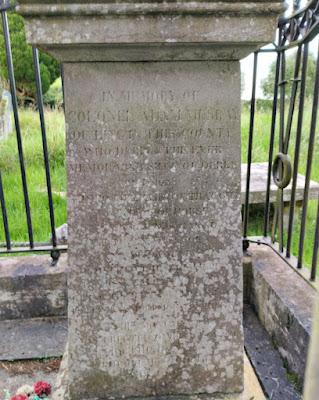
  Siege Myths and genealogy Colonel Adam Murray served as commander of the Williamite cavalry during the Siege, having raised a troop of 30 Horsemen for the city's defence. He was a key figure in the battles of Pennyburn (where he killed the French General Maumont in a sword fight) and Windmill Hill. Some siege accounts relate that the Jacobites captured Murray's elderly father, Gideon Murray and threatened to hang him unless the city surrendered. Apparently, Gideon Murray encouraged the defenders to continue fighting and to never surrender. Old Gideon Murray was spared by the Jacobites but died circa 1690. A Genealogical and Heraldic Dictionary of the Landed Gentry of G.B &  Ireland, (1863), volume 2 page 1058 by Bernard Burke states that Gideon Murray went to Ireland c1648 and settled at Ling in Cumber parish in Co. Derry. Murray  reputedly held considerable interest in the lands granted to the Skinners company, the lease of which passed from the family about 1805. ...

Snippets from the Derry Journal

Image
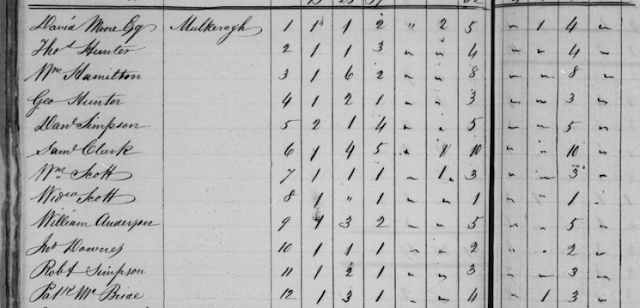
Local newspapers provide a rich font of information on regional history and give some insight into the daily lives of our ancestors. The Derry Journal was first published in 1772 and was first launched as the Londonderry and Donegal & Tyrone Advertiser. Below are a few snippets from the Derry Journal that are almost 200 years old and added commentary to give some context for the entries: Derry Journal 23 Sept 1828 Newtown Limavady cattle show - The Kennaght Branch of the North-West Society 5 Sept 1828: Prizes awarded - To farming servants for long and faithful service - first premium was awarded to Patrick McBride who has served under Mr William Scott of Mulkeeragh for 37 years; 2nd premium to David McKee who served Mr William Patton for 26 years. Note - many prize winners were listed in the article, many familiar names of local farmers all members of the Kennaght Branch of the NW Society. What is interesting here is the naming of farm servants - normally people who would not appea...